SodaSlim Official Website › Articles › Evidence That Stops At The Mouse
Raspberry Ketone: Evidence That Stops At The Mouse
One of the five botanicals on this bottle has no randomised human trial of any kind against body weight. It has cell work, a mouse study and a review that is candid about the gap. This is what that kind of evidence can and cannot be used for, and why the honest response is to say so.
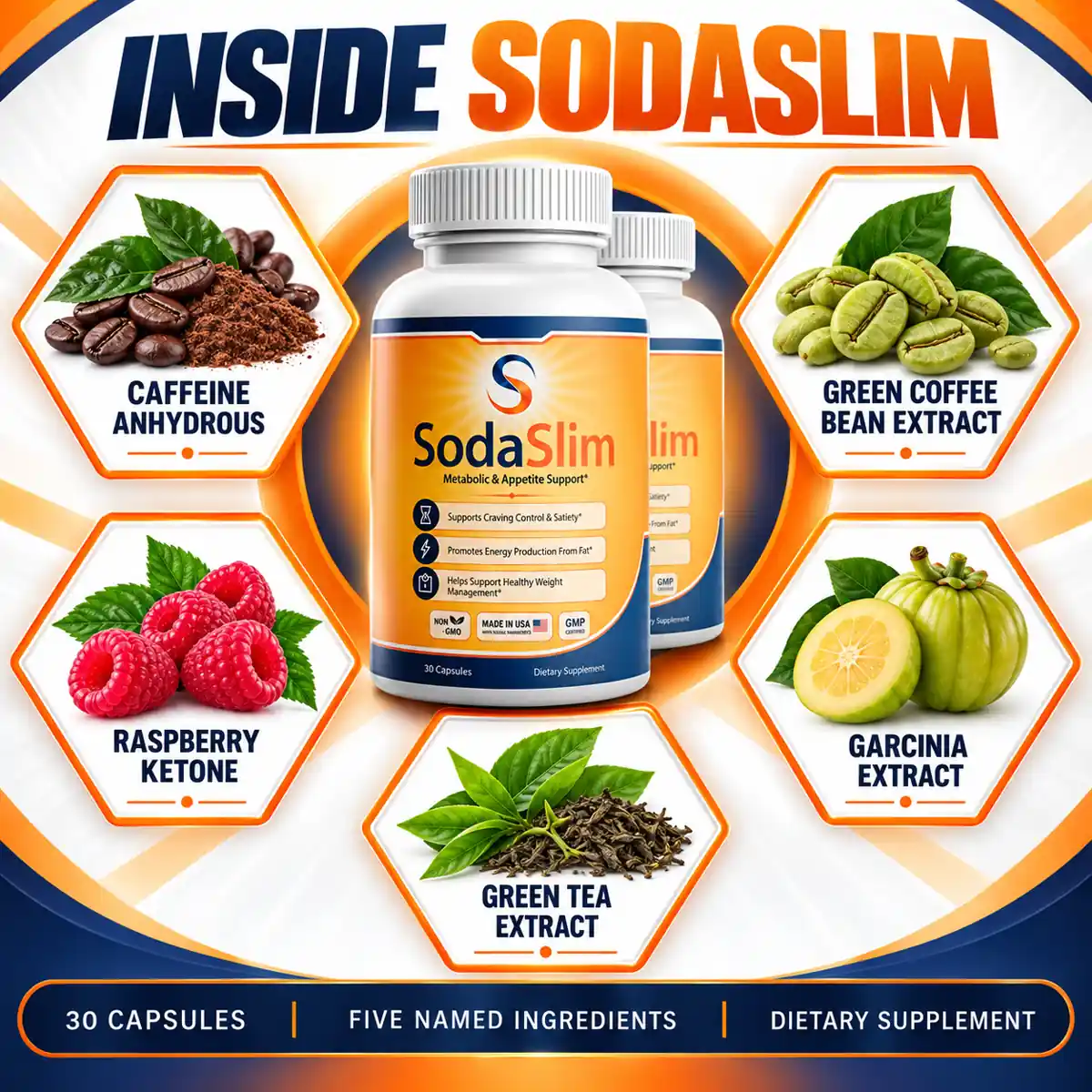
- Raspberry ketone is the compound behind the smell of raspberries, made industrially rather than extracted from fruit.
- There is no randomised human trial of it for body weight. The literature is a review, a cell study and a mouse feeding trial.
- In the mouse trial the animals ate less on the compound and did not lose fat beyond what the reduced eating explained.
- Animal doses were percentages of the diet by weight, which does not convert into a capsule for a person.
- This website records the refusal rather than dressing the animal work up as evidence.
What the compound is
Raspberry ketone is 4-(4-hydroxyphenyl)butan-2-one, the aromatic compound largely responsible for the smell of raspberries. At the quantities a supplement needs it is synthesised industrially; extracting it from fruit would cost more than the bottle several times over, and no product on this shelf claims otherwise in the small print.
The interest in it comes from structure. It resembles synephrine and capsaicin, both of which have some literature around lipolysis, and that resemblance is the origin of the claim that raspberry ketone might do something similar. That is a reasonable hypothesis and it is where the reasonable part ends.
It is also, commercially, an almost perfect ingredient: the name is pleasant, the mechanism sounds specific, and it cannot be contradicted by a trial that has never been run.
What evidence actually exists
A search of the published literature for this compound against human body weight returns three kinds of thing and not a fourth.
| What exists | What it is | What it can support |
|---|---|---|
| A 2021 pharmacological review | A survey of the published work | A description of what has been studied, and a caution that marketing runs ahead of it |
| A mouse feeding trial | High-fat-diet mice on 0.25 and 1.74 per cent of diet by weight | That the compound reduced food intake; it did not reduce fat beyond that |
| A stem-cell differentiation study | C3H10T1/2 cells in culture | That the compound is biologically active in cells |
| A randomised human trial of body weight | Does not exist | Nothing, because there is nothing |
A search of PubMed for raspberry ketone against human body weight returns reviews, cell work and animal work. The fourth row is the finding.
The second row is the most informative and the most often misrepresented. In the mouse feeding study, animals on a high-fat diet were given raspberry ketone at two levels for five weeks. The mice on the compound ate less. They did not reduce their fat beyond what eating less explained — which is to say the compound suppressed appetite in mice and did not, separately, do anything to their fat.
A marketing page can truthfully summarise that as ‘shown to reduce body fat in animal studies’. The sentence is technically accurate and it removes the only part of the finding that mattered.
The 2021 review is notably candid about the situation, noting that the compound is marketed at very high doses relative to anything that has been studied. A review saying so about an ingredient it is reviewing is worth reading.
Why the ladder of evidence matters here
Evidence comes in strengths, and supplement marketing exists largely in the gap between the bottom of the ladder and the top.
| Kind of evidence | What it tells you | What it cannot tell you |
|---|---|---|
| Cell culture | That a compound has an effect on cells in a dish | Whether the compound reaches those cells in a person, at any dose |
| Rodent feeding | What happens to an animal eating a percentage of its diet | What happens to a person swallowing a capsule |
| Uncontrolled human use | That people take it and some report an effect | Whether the effect is the compound or the attention |
| Randomised human trial | Whether it beats placebo, and at what dose | Whether it will do so for you specifically |
The ladder runs from weakest to strongest. Three of the four rungs exist for this ingredient and the fourth does not.
The distinction that does the work in this case is the third column of the second row. Animal feeding doses are expressed as a percentage of the diet by weight — 0.25 and 1.74 per cent in this study — and there is no honest way to convert that into a number of milligrams for a person. A mouse eats a proportion of its body mass daily that a human does not, and metabolic scaling between species is not a simple multiplication.
So there is no amount to put in the right-hand column of the comparison table on the ingredients page for this ingredient. Not because nobody looked, but because the thing that would go there has never been established.
Read the SodaSlim ingredient panels in full
Five botanicals, each with the trial that measures it and the amount that trial poured — including the one where the honest entry is that no human dose exists.
Three bottles $207 · sixty-day window · 60 days to change your mind
Choose A SodaSlim PackThirty capsules, thirty mornings · lot SOD-26/SO-3198 · ships from the U.S.
Why it is on the bottle at all
Three reasons, and only the first is respectable.
It might work. The structural argument is real, the cell data show biological activity, and an ingredient without a human trial is untested rather than disproved. That is a genuine distinction and it deserves stating before the other two.
It is cheap and it is familiar. Synthesised in bulk, it costs very little per capsule, and the name does marketing work on its own in a way that ‘4-(4-hydroxyphenyl)butan-2-one’ would not.
And it cannot be contradicted. An ingredient that has been properly tested can come back negative, as hydroxycitric acid did over twelve weeks at 1,500 mg a day, and then a retailer has to decide what to say about that result. An ingredient that has never been tested carries no such risk, which is a structural incentive in this category worth naming out loud.
What this desk does about it
Records the refusal, beside the evidence, and states it on every page where the ingredient appears. Raspberry ketone is described here as what it is: a compound with a plausible mechanism, activity in cells, one mouse study whose result was about appetite rather than fat, and no human trial.
The alternative would be to write ‘studies show raspberry ketone supports fat metabolism’, which is the sentence this ingredient usually gets and which is not false so much as constructed to be unfalsifiable. It is also the sentence a reader cannot check, and a page nobody can check is a page nobody should believe.
The wider reason to care is that this category has a documented integrity problem. An audit of the FDA tainted supplements database found approved and unapproved drugs turning up in products sold as supplements, with weight-loss products prominent. A shelf where untested ingredients are routinely described as proven is a shelf where a reader has no way of grading anything.
The four phrases that signal an untested ingredient
An ingredient with no human trial has to be described somehow, and the language that gets used is recognisable once you have seen it a few times. Four constructions do most of the work.
- “Studies show” without naming the species. Almost always animal or cell work. A human trial gets named, because naming it is the point.
- “Shown to support” rather than shown to do. Support is a verb that survives any result, which is why it is everywhere on this shelf.
- A mechanism described in unusual detail. Enzymes, receptors and pathways in place of an outcome. Mechanism is what you have when you do not have a result.
- A comparison to something else. ‘Structurally similar to’ is an argument about chemistry standing in for an argument about people.
None of those four is a lie and all four are compatible with an ingredient that has never been tested in a person. Learning to notice them is worth more on this shelf than memorising any particular fact about any particular botanical, and it is the reason the label-reading guide is written as a method rather than a ranking.
It is not disproved. Raspberry ketone may well do something in people; nobody has run the study that would show it. The complaint on this page is about language rather than about the compound.
What follows from all of this for a buyer is narrower than it might seem. One of five botanicals on this bottle is untested in people. Two of the other four have real human literature behind them and one of those two has the strongest evidence on the whole metabolism shelf. A formula is not its weakest ingredient any more than it is its strongest, and a reader who rejects this capsule solely because raspberry ketone is in it is applying a standard that would empty the category.
The fair conclusion is a smaller one. This ingredient should not be counted as a reason to buy, and any page that presents it as one has told you something about itself. Judge the bottle on the four that have been studied, treat the fifth as neutral, and read the ingredients page for what each of the four actually has behind it.
The reading method that separates this kind of claim from a tested one is on the label-reading guide, and the category-wide version is in the metabolism supplement guide, where animal-evidence ingredients are treated as one of the five families on this shelf rather than as an aberration.
References
- Rao S, Kurakula M, Mamidipalli N, et al. Pharmacological exploration of phenolic compound: raspberry ketone — update 2020. Plants (Basel). 2021;10(7). PMID 34209554. https://pubmed.ncbi.nlm.nih.gov/34209554/
- Cotten BM, Diamond SA, Banh T, et al. Raspberry ketone fails to reduce adiposity beyond decreasing food intake in C57BL/6 mice fed a high-fat diet. Food Funct. 2017;8(4):1512-1518. PMID 28378858. https://pubmed.ncbi.nlm.nih.gov/28378858/
- Takata T, Morimoto C. Raspberry ketone promotes the differentiation of C3H10T1/2 stem cells into osteoblasts. J Med Food. 2014;17(3):332-338. PMID 24404978. https://pubmed.ncbi.nlm.nih.gov/24404978/
- Heymsfield SB, Allison DB, Vasselli JR, et al. Garcinia cambogia (hydroxycitric acid) as a potential antiobesity agent: a randomized controlled trial. JAMA. 1998;280(18):1596-1600. PMID 9820262. https://pubmed.ncbi.nlm.nih.gov/9820262/
- White CM. Continued risk of dietary supplements adulterated with approved and unapproved drugs: assessment of the US Food and Drug Administration's tainted supplements database 2007 through 2021. J Clin Pharmacol. 2022;62(8):928-934. PMID 35285963. https://pubmed.ncbi.nlm.nih.gov/35285963/