SodaSlim Official Website › Articles › Your Daily Caffeine Total
SodaSlim And The Caffeine Arithmetic You Cannot Do
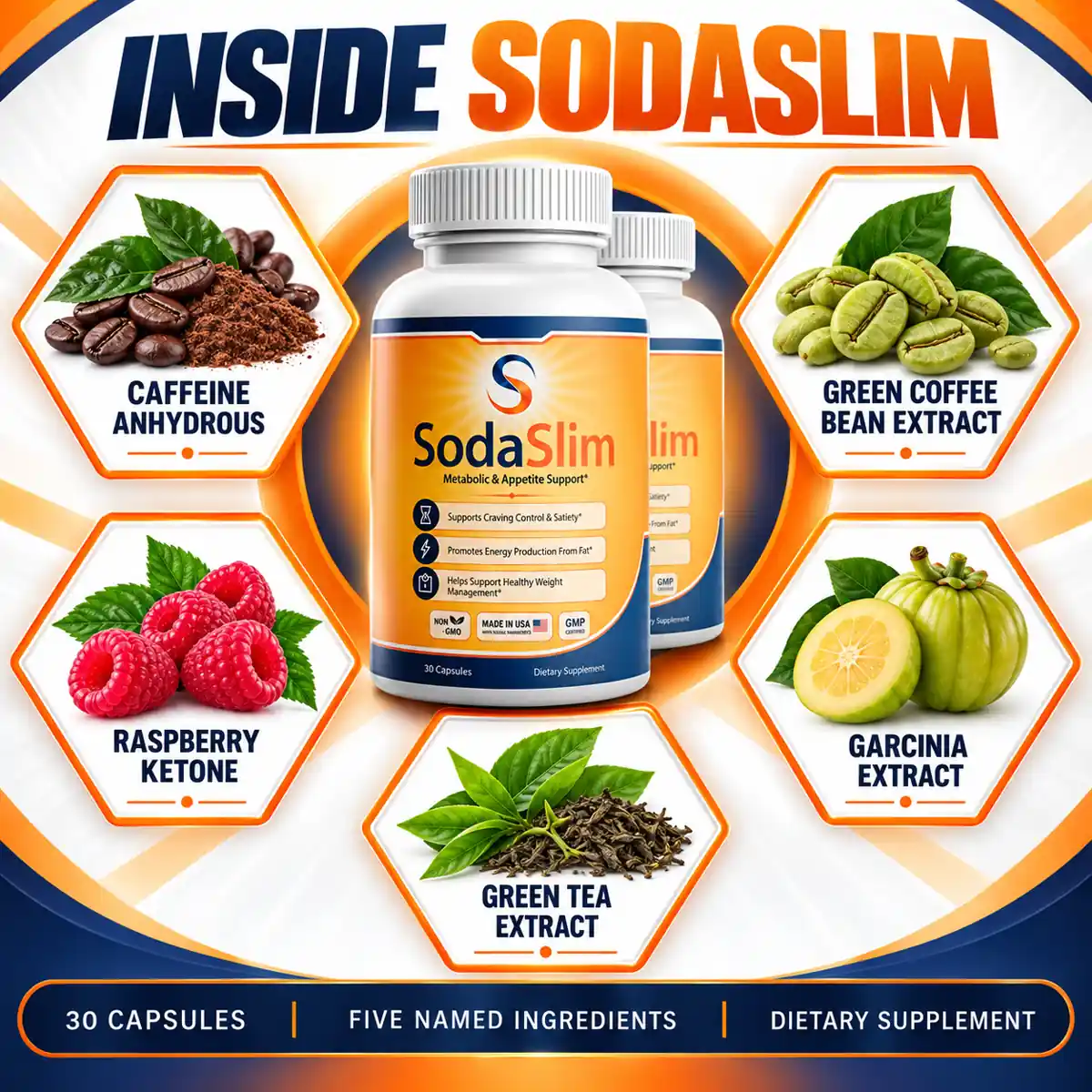
Caffeine anhydrous is the first name on this bottle and the only ingredient in it that does anything today. It is also the only ingredient whose amount a reader would genuinely use, and it is the one the label declines to give. This is what that costs, practically, on an ordinary morning.
- The reference point for healthy adults is 400 mg of caffeine a day from every source combined.
- Almost everything else you consume states its caffeine, or has a published average you can look up.
- This capsule states nothing, and caffeine reaches it from two of the five named botanicals rather than one.
- So the day's total becomes a known number plus an unknown one, which is not a number.
- The workable response is to make room rather than to calculate: drop one habitual coffee for the first fortnight.
Why the amount is the one figure that would have mattered
Most ingredient amounts on a supplement label are interesting rather than urgent. Knowing whether a capsule holds 200 mg or 400 mg of a botanical extract tells you something about value and very little about your afternoon.
Caffeine is the exception, and it is the exception for a reason worth stating precisely: it is the only ingredient in this formula with a dose-dependent effect that a person experiences the same day. Everything else on this panel operates over weeks, invisibly, and a reader has no way of noticing whether the amount was right or wrong. A stimulant announces itself.
It is also dose-dependent in the direction that matters. A dose-response meta-analysis of caffeine and blood pressure found supplementation above 400 mg a day raised diastolic pressure, and a randomised trial of high-volume energy drink consumption measured electrocardiographic changes alongside blood-pressure ones. Neither study was about this capsule. Both are about why the total is the thing worth watching.
So the label's silence is not evenly distributed across its five names. Four of the silences cost a reader the ability to judge value. The fifth costs them the ability to manage their own day, and that is a different order of problem.
Why nobody prints it
There are three ordinary reasons a manufacturer might leave a caffeine figure off a panel, and none of them requires bad faith.
The first is that the formula is a proprietary recipe and the company does not want to publish the ratio it arrived at. That is a commercial position rather than a deception, and it is the usual justification for a proprietary blend.
The second is that printing a number invites comparison. A capsule stating 60 mg of caffeine sits beside a competitor stating 200 mg and looks weaker, whether or not 60 mg is the better formulation choice.
The third is simply that the shelf does not require it. Half the metabolism category prints a full panel and half does not, and the half that does not faces no commercial penalty for it, because most buyers never look. A disclosure standard that nobody enforces is a standard that erodes.
None of those three is a reason for a reader to accept the gap. They are reasons to understand why it exists, and to notice that all three are about the seller's position rather than the buyer's.
What you can count, and what you cannot
The useful way to see the gap is to lay this capsule beside everything else a person might have on an ordinary Tuesday.
| Source | Does it state its caffeine? | Can you add it up? |
|---|---|---|
| A cup of coffee | No, but published averages exist | Approximately |
| A can of cola | Usually on the label | Yes |
| An energy drink | Almost always, prominently | Yes |
| A pre-workout powder | Yes, per scoop | Yes |
| This capsule | No figure is published anywhere | No |
Four of these five can be entered into a daily total. The fifth is why this article exists.
Four of those five are countable. Coffee has no label but has well-established published averages; a cola, an energy drink and a pre-workout all print their caffeine and print it prominently, because their entire proposition is the stimulant.
The fifth breaks the sum. Not because the amount is necessarily large — it could be small — but because an unknown added to a known number does not produce a number. A reader who was successfully keeping to a self-imposed limit stops being able to tell whether they still are.
The forensic literature on caffeine is largely a catalogue of sources people did not count: supplements, energy products, and preparations whose caffeine content was not where the consumer was looking. An unlabelled source is, by construction, one of those.
| What you drink in a day | Roughly | What the capsule does to that figure |
|---|---|---|
| One mug of filter coffee | 95 mg | An unknown on top of a modest base. The gentlest place to begin. |
| Two mugs | 190 mg | Still under half the reference point before the capsule is counted. |
| Three mugs | 285 mg | The unknown now sits on top of a figure already close to the reference point. |
| One large takeaway cup | Up to 300 mg | A single drink can do what three home mugs do. Cup size is the variable people forget. |
| Two coffees and a pre-workout | About 400 mg | The stated numbers already reach the reference point. The capsule is extra. |
Approximate figures for ordinary drinks, given so a reader can do the arithmetic that IS available to them. The 400 mg reference point for healthy adults is a total from every source combined.
Caffeine reaches this capsule from two ingredients, not one
There is a second complication and it is easy to miss on a front panel. Caffeine anhydrous is the obvious source. Green tea extract is the other one, and green coffee bean extract is a third depending on how it was prepared.
That means even a label that printed a milligram figure beside each of the five names would still require a reader to identify which of them carry caffeine and add them together. Most readers would not. A single stated caffeine total is what somebody actually needs, and it is the line this website argues most strongly for on the label-reading guide.
On this bottle none of that arises, because no figure exists at any level. But it is worth knowing when you compare it with something on the shelf that does print a panel: a per-ingredient breakdown without a total is a partial answer rather than a full one.
Start SodaSlim on the smaller rung
Two bottles is sixty mornings, which is exactly as long as the window that covers it. It is the cheapest way to find out whether a morning capsule with a stimulant in it agrees with you.
Two bottles $158 · three bottles $207 · 60 days to change your mind
Choose A SodaSlim PackThirty capsules, thirty mornings · lot SOD-26/SO-3198 · ships from the U.S.
What to actually do about it
The arithmetic is unavailable, so the practical response is not to calculate but to make room. Three things, in order of usefulness.
- Drop one habitual coffee for the first fortnight. Not forever, and not as a precaution in the abstract. It is the only way to create space for an unmeasured addition, and a fortnight is long enough to tell whether the space was needed.
- Take it in the morning, as the label says. The instruction exists because a stimulant taken at three in the afternoon is a stimulant reaching your bedtime, and sleep is not a side issue for anybody trying to manage appetite.
- Do not stack it on a pre-workout. Those state their caffeine, usually between 150 and 300 mg a scoop. Adding a stated number to an unstated one produces a total nobody can check, on the day you least want a surprise.
There is a fourth thing, and it applies before any of the others. If you are in one of the four groups the manufacturer's own caution names — pregnant, nursing, sensitive to stimulants, or living with high blood pressure — the missing figure is not an inconvenience but the whole problem, and the conversation to have is with a clinician rather than with a website. The caution is quoted in full on the side-effects page.
SodaSlim is a dietary supplement, not a drug, and it is not FDA-approved. Its statements have not been evaluated by the Food and Drug Administration and it is not intended to diagnose, treat, cure or prevent any disease. Anyone taking prescription medicine, and anyone in the four groups the label's own caution names, should speak to a clinician before the first capsule.
And what happens when you stop
One thing almost nobody plans for. If a bottle runs out, or the window closes and the decision is made, the capsule stops being part of a routine that has been running for two months.
The caffeine withdrawal literature describes headache and fatigue on abrupt cessation, and the effect is real enough to have its own diagnostic description. A reader who stops after two bottles and feels worse for three days may reasonably conclude that the capsule was doing something after all. What they are feeling is the absence of a stimulant rather than the absence of a metabolic effect.
It is also a reason to taper the coffee back up rather than replacing the capsule with two extra cups in the same week. The reference point for healthy adults is 400 mg a day from every source, and it applies on the way down as much as on the way up.
A worked example, on an ordinary Tuesday
Take somebody who has decided, sensibly, to keep under 400 mg a day. Two mugs of filter coffee at breakfast puts them at about 190 mg. A takeaway cup at eleven, bought without thinking about size, might add 200 more. They are now at roughly 390 mg and they know it, because every one of those numbers is published somewhere they could look it up.
Add a capsule at eight in the morning and the figure stops being 390 mg. It becomes 390 mg plus something. If the something is 40 mg they are fine; if it is 150 mg they are well past a limit they were carefully observing. Nothing in the label, the seller's page or the batch paperwork distinguishes those two worlds.
The thing to notice is that this person did nothing careless. They counted everything that was countable, and the one item that was not countable was the one sold specifically for its effect on metabolism and energy. That is the whole argument of this article in a single morning.
This capsule is not necessarily a large caffeine source. It is an uncountable one, and that is a different problem with a different solution: make room for it rather than trying to measure it.
The product-page version of this argument, with the five botanicals and the amounts the published trials used, is on the ingredients page. What a label would have to print to make the arithmetic possible is on the label-reading guide.
References
- Nawrot P, Jordan S, Eastwood J, et al. Effects of caffeine on human health. Food Addit Contam. 2003;20(1):1-30. PMID 12519715. https://pubmed.ncbi.nlm.nih.gov/12519715/
- Musgrave IF, Farrington RL, Hoban C, Byard RW. Caffeine toxicity in forensic practice: possible effects and under-appreciated sources. Forensic Sci Med Pathol. 2016;12(3):299-303. PMID 27344159. https://pubmed.ncbi.nlm.nih.gov/27344159/
- Abbas-Hashemi SA, Hosseininasab D, Rastgoo S, et al. The effects of caffeine supplementation on blood pressure in adults: a systematic review and dose-response meta-analysis. Clin Nutr ESPEN. 2023;58:165-177. PMID 38057002. https://pubmed.ncbi.nlm.nih.gov/38057002/
- Shah SA, Szeto AH, Farewell R, et al. Impact of high volume energy drink consumption on electrocardiographic and blood pressure parameters: a randomized trial. J Am Heart Assoc. 2019;8(11):e011318. PMID 31137991. https://pubmed.ncbi.nlm.nih.gov/31137991/
- Griffiths RR, Chausmer AL. Caffeine as a model drug of dependence: recent developments in understanding caffeine withdrawal, the caffeine dependence syndrome, and caffeine negative reinforcement. Nihon Shinkei Seishin Yakurigaku Zasshi. 2000;20(5):223-231. PMID 11326548. https://pubmed.ncbi.nlm.nih.gov/11326548/