SodaSlim Official Website › Articles › Four Lines That Would Fix This Label
Four Lines That Would Make This SodaSlim Label Checkable
Complaining about a front panel is easy. Saying what the better version would print is harder and more useful. Four lines would answer almost every open question on this website, none of them requires a change to the formula, and roughly half the metabolism shelf already prints them.
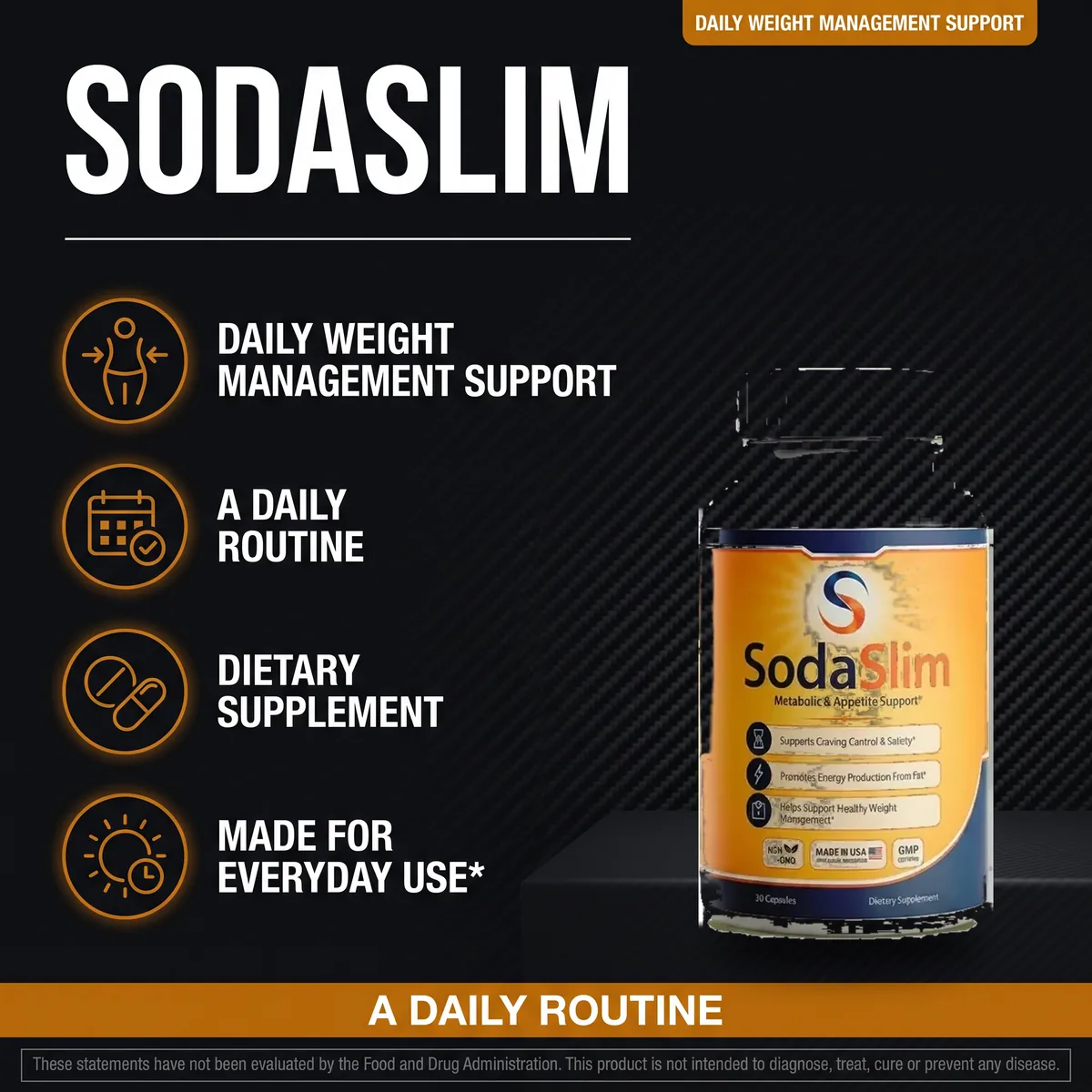
- A serving weight sets the ceiling for everything else and is the first thing missing.
- An amount beside each of the five names would allow a direct comparison with the trials.
- A standardisation percentage is what makes an extract comparable at all.
- A stated caffeine total matters more here than anywhere, because caffeine arrives from two of the five ingredients.
- None of the four requires a new factory. They require a decision to print.
The four lines
| The line | What it would say | What it would let you check |
|---|---|---|
| Serving size and weight | 1 capsule, NNN mg | The ceiling for everything else. Whether trial-sized amounts could fit at all |
| An amount per ingredient | Caffeine anhydrous NNN mg, and so on for five | A direct comparison with every trial cited on this website |
| A standardisation percentage | Green tea extract, NN% EGCG | Whether an extract resembles the one that was studied |
| A caffeine total | Total caffeine NNN mg per capsule | Your day's total, against the 400 mg reference point for healthy adults |
Four lines. None of them requires a new formula, a new factory or a new supplier — only a decision to print.
That is the whole proposal. It is not a demand for third-party testing, not a call for new trials, and not a criticism of the ingredients chosen — the formula contains the two families with the best evidence on this shelf, which is set out on the category guide.
It is a request for four printed lines, and the reason it is worth making is that each one converts an act of trust into an act of checking. A reader holding a panel with all four can compare the bottle in their hand with the published record, without asking anybody's permission and without believing a word on this website.
Why the serving weight comes first
Because it is the line that makes all the others meaningful, and because on its own it already tells you something.
A capsule has a finite internal volume. Once you know it holds, say, 500 mg of material in total, you can set that against the amounts the trials used.
| Trial | Amount it used | Could it fit in one capsule? |
|---|---|---|
| Garcinia, JAMA | 1,500 mg of hydroxycitric acid a day | Not alongside four other ingredients |
| Green coffee, pooled | At least 500 mg of chlorogenic acid a day | Only if it were most of the capsule |
| Green tea, chamber trial | 90 mg EGCG three times a day, with caffeine | Possibly, at a stretch |
| Green tea, safety review | 338 mg of EGCG a day as a safe intake level | Relevant in the other direction |
| Caffeine, reference point | 400 mg a day from all sources | The figure a total would be measured against |
This arithmetic is the reason the four lines matter. Without a serving weight none of these comparisons can be made at all, in either direction.
Read the third column. Two of these five research amounts could not fit into a single capsule alongside four other ingredients under any arrangement. That is not a secret and it is not an accusation: it is what happens when a category sells five-ingredient formulas in one daily capsule, and it is true across most of this shelf rather than uniquely here.
The point is that a reader with a serving weight could work it out in thirty seconds and then decide for themselves what to make of it. A reader without one cannot even begin, and the difference between those two positions is the whole subject of this article.
The SodaSlim comparison table, in full
Five botanicals against five published trial amounts, on the page this article is arguing about — and sixty days from purchase to decide what the gap is worth.
Three bottles $207 · sixty-day window · 60 days to change your mind
Choose A SodaSlim PackThirty capsules, thirty mornings · lot SOD-26/SO-3198 · ships from the U.S.
Why a percentage matters more than a milligram
This is the line readers skip and it is arguably the most important of the four.
An extract is a weight of plant material, and the fraction of it that is the active compound varies enormously between suppliers. Green tea extract standardised to 50 per cent EGCG and green tea extract standardised to 5 per cent are both honestly described as green tea extract. One is ten times the other.
So a panel that prints ‘green tea extract 200 mg’ has told you almost nothing. The number you would need to compare against the chamber trial, which used 90 mg of EGCG three times a day, is the EGCG content rather than the extract weight, and only a standardisation percentage yields it.
The same applies in the safety direction. The systematic review that proposed 338 mg of EGCG a day as a safe intake level for a solid dose was talking about EGCG, not about extract. A reader cannot place a product against that figure without the percentage either.
- Extract weight alone: not comparable with any trial.
- Extract weight plus standardisation: comparable with every trial.
- The same argument applies to the green coffee extract and its chlorogenic acid content.
- Two of the five botanicals on this label are extracts, so the percentage matters twice over.
The fifth line, which is harder
A fifth line would be better still and is a genuinely bigger ask: an independent test result for the batch, published and dated.
That is a laboratory document rather than a printing decision. It would report identity, potency, heavy metals, microbiology and a screen for undeclared pharmaceutical compounds, and it is the only kind of evidence that speaks to what is actually inside a capsule rather than what a manufacturer intended to put there.
Its scarcity across this whole shelf is the category's real problem rather than any single manufacturer's. An audit of the FDA tainted supplements database found approved and unapproved drugs turning up in products sold as supplements between 2007 and 2021, with weight-loss products prominent among them. Independent testing is what catches that, and most of this shelf does not publish any.
What this product carries is a lot number and a certificate reference, both described in the supplied pack as filing references rather than laboratory proof. The batch page sets out what they can and cannot be used for, which is narrower than it sounds and still worth having.
What printing them would cost
Almost nothing, which is the uncomfortable part.
Ink, essentially. A back panel already exists on most bottles in this category; the four lines are a decision about what goes on it. There is no new supplier to find, no reformulation, no additional testing required to print an amount a manufacturer already knows because it wrote the recipe.
What it would cost is the ability to be compared. A manufacturer printing 90 mg of an extract has invited every reader to set that number against a trial that used 500 mg, and a proportion of them will decide against buying. That is the real trade, and naming it is more honest than pretending disclosure is difficult.
Which leaves the reader with the decision this website keeps returning to. Either the missing lines matter enough to stop you buying — a defensible conclusion that no refund window offsets — or they do not, in which case the sixty-day window and the published lot number make the purchase a reasonable thing to test. Both readings survive reading this article. Only one of them survives a page that pretended the lines were there.
What a reader can do in the meantime
None of this is within a buyer's control, so the useful question is what to do with a label that prints none of the four lines. Three answers, in ascending order of commitment.
- Use the research amounts as a sense of scale. They are on the ingredients page, in the trials' own units. They do not tell you what is in the capsule; they tell you what size of thing the question is about.
- Treat the stimulant as uncountable rather than small. Make room for it instead of trying to calculate it. That is the whole of the caffeine article.
- Buy from a desk with a window you can actually use. Sixty days from purchase, opened bottles included, and a telephone number that can authorise a return. A window is the only instrument a buyer holds when the label will not answer.
That last point is a commercial answer to an informational problem, and it is worth being honest about the substitution. A refund window does not tell you what is in a capsule. It tells you that finding out for yourself is affordable, which is a different and lesser thing — and on a shelf where half the panels are blank, it is what is available.
SodaSlim is a dietary supplement, not a drug, and it is not FDA-approved. Its statements have not been evaluated by the Food and Drug Administration and it is not intended to diagnose, treat, cure or prevent any disease. Anyone taking prescription medicine, and anyone in the four groups the label's own caution names, should speak to a clinician before the first capsule.
The reading method behind all of this is on the label-reading guide, and the worked example is the ingredients page.
References
- Nawrot P, Jordan S, Eastwood J, et al. Effects of caffeine on human health. Food Addit Contam. 2003;20(1):1-30. PMID 12519715. https://pubmed.ncbi.nlm.nih.gov/12519715/
- Dulloo AG, Duret C, Rohrer D, et al. Efficacy of a green tea extract rich in catechin polyphenols and caffeine in increasing 24-h energy expenditure and fat oxidation in humans. Am J Clin Nutr. 1999;70(6):1040-1045. PMID 10584049. https://pubmed.ncbi.nlm.nih.gov/10584049/
- Hu J, Webster D, Cao J, Shao A. The safety of green tea and green tea extract consumption in adults — results of a systematic review. Regul Toxicol Pharmacol. 2018;95:412-433. PMID 29580974. https://pubmed.ncbi.nlm.nih.gov/29580974/
- Kanchanasurakit S, Saokaew S, Phisalprapa P, Duangjai A. Chlorogenic acid in green bean coffee on body weight: a systematic review and meta-analysis of randomized controlled trials. Syst Rev. 2023;12(1):163. PMID 37710316. https://pubmed.ncbi.nlm.nih.gov/37710316/
- Heymsfield SB, Allison DB, Vasselli JR, et al. Garcinia cambogia (hydroxycitric acid) as a potential antiobesity agent: a randomized controlled trial. JAMA. 1998;280(18):1596-1600. PMID 9820262. https://pubmed.ncbi.nlm.nih.gov/9820262/
- White CM. Continued risk of dietary supplements adulterated with approved and unapproved drugs: assessment of the US Food and Drug Administration's tainted supplements database 2007 through 2021. J Clin Pharmacol. 2022;62(8):928-934. PMID 35285963. https://pubmed.ncbi.nlm.nih.gov/35285963/